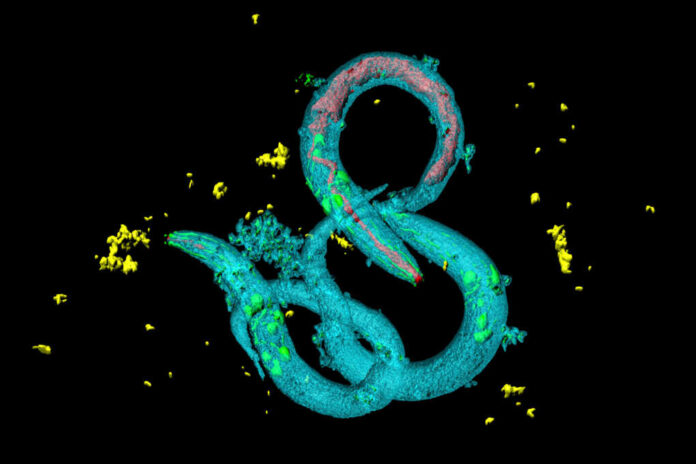
Discover how the humble worm, *Caenorhabditis elegans*, might hold the key to unlocking longer, healthier human lives.
Story Highlights
- Research on *C. elegans* reveals potential pathways to extend human lifespan.
- Key findings involve glial cells, insulin/IGF-1 signaling, and stress response.
- Discoveries could lead to new anti-aging therapies.
- Ongoing research aims to translate these findings to human health.
Worms Provide Insight into Longevity
*Caenorhabditis elegans*, a tiny worm, has long been a favorite model organism for scientists studying aging due to its genetic simplicity and short lifespan. Recent studies have unveiled its potential to unlock secrets of human longevity. Key findings from various studies point to the manipulation of specific cellular pathways and genes, such as those associated with glial cells, which can significantly extend the worm’s lifespan and healthspan.
Researchers have focused on the role of glial cells, non-neural cells that support neurons, discovering that changes in their chemistry can promote longer lifespans. This insight challenges the previous neuron-centric view of aging and opens new avenues for exploring anti-aging interventions in humans.
🍄 NEW: A tiny worm just revealed a big secret about living longer… https://t.co/XwPYfvtBGn #medicinalmushrooms #fungi
— Mr. Fun Guy Markets (@MFGMushrooms) November 16, 2025
Conserved Pathways and Their Potential
In the 1990s, the insulin/IGF-1 signaling pathway was identified as a major player in the regulation of longevity in *C. elegans*. This pathway, conserved across species, is now a focal point in aging research. Studies have demonstrated that interventions targeting this pathway can enhance stress resistance and improve mitochondrial function, both linked to longevity.
Recent publications have highlighted how compounds like 20(S)-protopanaxadiol (20(S)-PPD) and deguelin extend lifespan through distinct molecular mechanisms. These discoveries not only deepen our understanding of aging but also suggest potential therapeutic targets for human aging and age-related diseases.
Translational Potential for Human Health
The implications of these findings are profound. By understanding how specific pathways and cellular mechanisms in *C. elegans* correlate with longevity, scientists hope to develop interventions that can delay aging and mitigate cognitive decline in humans. This research has sparked interest in the broader aging research community and the pharmaceutical industry, both eager to translate these findings into viable treatments.
As research continues, validation in mammalian models is critical to ensuring these pathways can be effectively targeted in humans. The potential development of drugs or therapies inspired by these studies could revolutionize how we approach aging and age-related diseases, possibly leading to a future where extended healthspan is a reality for many.
Sources:
Frontiers in Pharmacology
PubMed Central
University of Miami News
eLife Sciences
Nature Communications
Micropublication Biology