You don’t have to get down on the floor to strengthen your glutes, and a growing number of trainers are showing older adults exactly how to skip that step.
Story Snapshot
- Fitness instructors are teaching standing, wall-supported hip extensions as an alternative to traditional floor glute bridges.
- AARP recommends performing the bridge on a bed for people who struggle to get up and down from the floor.
- The standing version uses a wall or chair for balance, with 8 to 10 reps per leg and slow, controlled motion.
- Muscle activation studies show wide variation between glute exercises, so results can differ person to person.
Why The Floor Is The Problem, Not The Exercise
The classic glute bridge works. You lie on your back, feet flat, and lift your hips toward the ceiling. The trouble isn’t the movement itself. It’s getting down there and, more importantly, getting back up. For many adults over 50, that transfer is harder than the exercise it leads to, and it can discourage people from training their glutes at all.
AARP’s own exercise guidance acknowledges this gap directly, suggesting a glute bridge performed on a bed for anyone who cannot comfortably get up and down from the floor. That small adjustment keeps the hip-extension pattern but removes the barrier that stops people from starting in the first place. Other senior fitness resources echo the same concern, noting that standard floor positioning simply doesn’t work for every body.
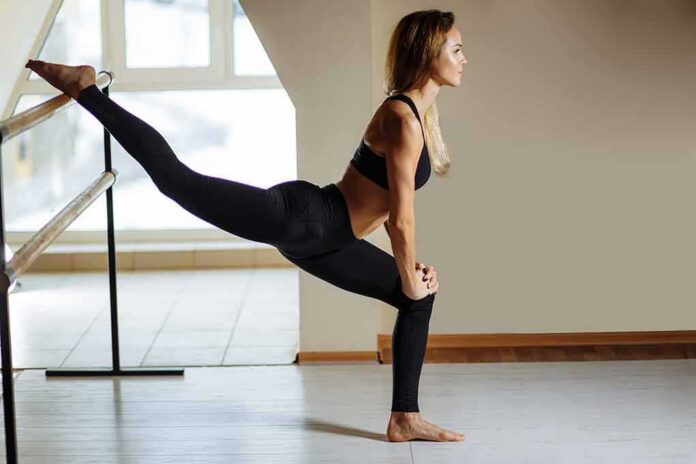
A Senior Wellness Hub video takes the modification a step further. Instead of lying down at all, it teaches a standing hip extension, sometimes called a kickback. You hold onto a wall or chair, kick one leg back and squeeze the glute, then switch sides. The routine calls for 8 to 10 repetitions per leg, slow tempo, and gradual progression over several weeks rather than pushing hard on day one.
What The Standing Version Actually Trains
Senior exercise guides describe the standing hip extension as a legitimate way to strengthen the gluteus maximus and improve hip mobility, using a countertop or chair purely for balance support. That balance point matters. Someone unsteady on their feet needs something sturdy to hold, and the exercise is built around that support rather than treating it as optional.
The payoff is practical, not just muscular. Stronger glutes and legs support everyday movements like climbing stairs and walking without strain. That’s the real selling point for this crowd. Nobody over 50 is chasing a bodybuilder physique here. They want to carry groceries, climb a porch step, and get out of a car without their hip giving out.
Where The Science Gets Honest About Limits
Here’s the part worth sitting with. Researchers who study muscle activation with electromyography have found that body-weight hip extension exercises produce wildly different results, ranging from about 6 percent to over 100 percent of a reference muscle contraction. In plain terms, calling two movements both a glute exercise doesn’t mean they work the muscle the same amount or the same way.
That doesn’t make the standing kickback a bad choice. It means nobody should assume it’s a perfect stand-in for a floor bridge just because both target the same muscle group. The honest answer is that the standing version is a different exercise with its own benefits, not a secret twin of the bridge wearing a disguise.
Safety guidance across the board lands on the same common-sense advice. Consult a doctor before starting any new routine, especially with joint, heart, or balance concerns, and stop immediately if a movement causes pain. That’s not a legal disclaimer tacked on for show. It’s the same advice a good trainer would give a friend before handing them a resistance band.
The Bottom Line For Anyone Over 50
Pick the version that gets you moving consistently. If the floor is the obstacle, a bed bridge or a wall-supported standing kickback keeps you training without the fight to get up afterward. The goal was never to copy a textbook. It’s to keep hips strong, legs steady, and stairs manageable for as long as possible, using whatever stable surface is within reach.
Sources:
melioguide.com, silverstrength.club, health.clevelandclinic.org, agebold.com