Ten quiet minutes under red light might do more for your thinning hair than a decade of expensive shampoos and broken promises.
Story Snapshot
- Low-level red light therapy at home can increase hair density and shaft thickness in just 10-minute sessions.
- Clinical trials on 650–655 nm light show 20–40% gains in terminal hair counts over 14–26 weeks.
- The mechanism targets follicle mitochondria, boosting energy and growth signals instead of hormones.
- Evidence suggests the greatest benefit for early pattern hair loss, especially combined with other conservative treatments.
The quiet revolution in hair loss nobody advertised on TV
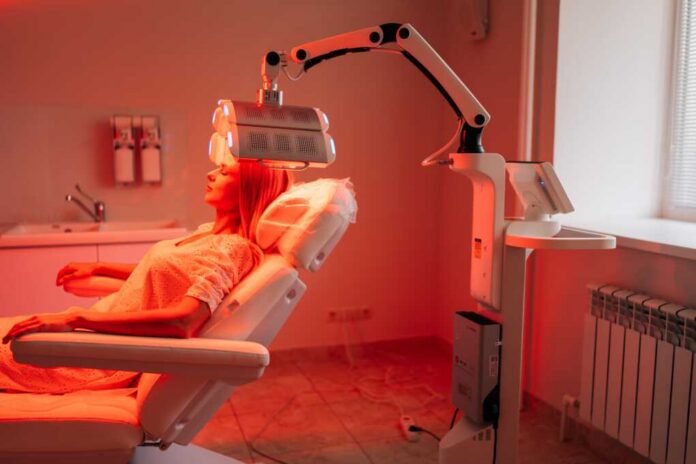
Most people over 40 know the usual hair loss script: a lifetime subscription to minoxidil, uncomfortable side effects from finasteride, or a $4,000 transplant that may or may not look like your original hairline. Researchers quietly spent the last decade testing a different path: ten-minute sessions of 650–655 nm red light, delivered by helmets or caps, that push follicles to act younger and more productive without touching your hormones. For once, the before-and-after photos have controlled trials behind them, not just clever lighting.
Clinical trials on pattern baldness patients report density increases in the range of 20–40% after 14–26 weeks of regular sessions compared with sham devices. One helmet protocol using 655 nm light at around 67 J/cm² produced roughly 35% hair count growth at 16 weeks, a result that puts it in the same conversation as mainstream pharmacologic options, but without the same systemic risk profile.
Watch:
Got a health question? Ask our AI doctor instantly, it’s free.
What ten minutes of red light actually does to a hair follicle
Low-level light therapy sounds like wellness marketing until you examine the biology. Photobiomodulation targets cytochrome c oxidase in the follicle’s mitochondria, increasing ATP production and reducing oxidative stress. That extra cellular energy appears to push slow, miniaturizing follicles back toward active growth, with ex vivo human follicle studies at around 650 nm showing greater shaft elongation and elevated proliferation markers like Ki67 compared with controls. Those are not vague wellness claims; they are measurable cellular changes that align with thicker, longer hair shafts over time.
Meet My Healthy Doc – instant answers, anytime, anywhere.
How red light compares with injections, pills, and supplements
Platelet-rich plasma (PRP) earns attention in dermatology circles, with trials showing terminal hair count increases of roughly 33 hairs in treated areas, but sessions last about 30 minutes and involve injections across multiple monthly visits. Dietary supplements aimed at women with thinning hair report around 10% density gains over several months, often relying on self-reported outcomes and slower timelines. Ten-minute red light helmets sit between those extremes: more objective data than most nutraceuticals, less invasiveness and time burden than PRP, and no systemic hormonal manipulation like finasteride.
Watch:
Who is shaping the narrative, and who actually benefits?
Academic dermatologists and photobiology researchers created the underlying evidence, but companies now hold most of the practical power because they package the science into $500–$1,000 consumer helmets. FDA clearances depend on those same trials, granting these devices a regulatory legitimacy that typical beauty gadgets lack. This collaboration between labs and manufacturers raises a fair question: are we seeing honest translation of data or just another way to monetize middle-aged anxiety about the bathroom mirror?
Your instant doctor companion – online 24 hours a day.
Sources:
Platelet-Rich Plasma for the Treatment of Androgenic Alopecia: A Randomized, Placebo-Controlled, Double-Blind Clinical Study
A Randomized, Placebo-Controlled Clinical Study Evaluating a Dietary Supplement for Hair Growth
Hair Growth-Promoting Effects of 650 nm Red Light Stimulation on Human Hair Follicles: An Ex Vivo Study
Low-Level Laser (Light) Therapy (LLLT) for Treatment of Hair Loss
NCT04019795: Light-Based Hair Regrowth Study (REVIAN)
Photobiomodulation for the Treatment of Hair Loss
Hair Restoration: Emerging Light-Based Therapies