Most people treating acne are solving the wrong problem — and a dermatology physician associate just laid out exactly why on YouTube.
Quick Take
- Acne has four root causes, and most over-the-counter products only target one or two of them.
- You may not even have acne — three common skin conditions mimic it and won’t respond to acne treatment at all.
- All 0.1% adapalene products contain the same active ingredient by law, so buying the expensive brand is wasted money.
- Acne treatments need 8 to 12 weeks to work — most people quit too early and blame the product.
The Four Reasons Your Skin Keeps Breaking Out
Tyler, a licensed Dermatology Physician Associate-Certified, built his “acne pyramid” framework around four factors that drive every pimple: excess oil production, too many skin cells clogging pores, overgrowth of a bacteria called Cutibacterium acnes, and inflammation. Most drugstore products chase only one of these. That is why someone can use a salicylic acid wash for months and still break out — they are treating one factor while the other three run unchecked.
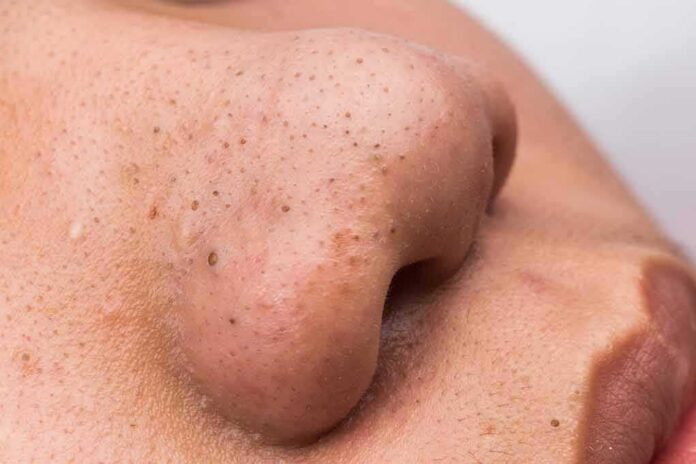
Tyler separates acne lesions into two groups: non-inflammatory (blackheads and whiteheads) and inflammatory (papules, pustules, nodules, and cysts). This matters because the treatment approach differs. A blackhead is a clogged pore exposed to air. A cyst is a deep, painful infection under the skin. Treating both the same way is like using a bandage on a broken bone. Understanding which type you have determines which rung of the treatment ladder you start on.
You Might Not Have Acne at All
This is the part most skincare content skips. Tyler identifies three conditions that look like acne but are not. Perioral dermatitis shows up as small red bumps around the mouth and nose. Fungal acne appears as itchy, uniform bumps caused by yeast, not bacteria. Acne rosacea produces redness and flushing but no comedones — the blackheads and whiteheads that define true acne. Apply standard acne products to any of these and you will likely make them worse, not better.
The Brand Name Myth Is Costing You Money
Tyler makes a point that should save people real money. The Food and Drug Administration regulates 0.1% adapalene as a drug ingredient. Every product at that concentration contains the exact same active compound by law. The expensive branded version and the store-brand version are chemically identical where it counts. Tyler’s advice: buy the cheapest one. The same logic applies to benzoyl peroxide, where concentrations range from 2.5% to 10%, and higher does not always mean better — it often just means more irritation.
For hormonal acne, Tyler points to prescription options like spironolactone and a newer drug called Winlevi. For severe cystic acne, he cites isotretinoin — commonly known as Accutane — and claims roughly 70% of patients achieve long-term remission. That statistic is compelling, though Tyler does not name the specific clinical study behind it, which is a gap worth noting for anyone making a major treatment decision. For moderate acne, peer-reviewed research confirms that combining a topical antibiotic, a retinoid, and benzoyl peroxide ranks as the second most effective pharmacological approach after oral isotretinoin.
Why Most People Quit Right Before It Works
Tyler draws a clear line between purging and irritation — two reactions people often confuse. Purging is an initial worsening in the areas already being treated, a normal sign the product is working. Irritation is redness and breakouts appearing in new areas right away, a sign the product is too harsh. The treatment window he cites is 8 to 12 weeks before real improvement shows. Clinical studies back this up — a pilot study published in the Journal of Clinical and Aesthetic Dermatology showed statistically significant acne improvement at the 8-week mark with proper regimen adherence.
The Bigger Problem With Skincare Advice Online
Tyler’s framework is grounded in real clinical knowledge, and his credentials as a Dermatology Physician Associate-Certified give it weight. But the broader landscape of skin advice online is a minefield. Research on dermatology content on TikTok found that the most-viewed creators score poorly on educational accuracy, with reliability scores ranging from 1.47 to 2.66 on a scale where anything under 3 is considered poor quality. [12] Board-certified dermatologists created as few as 0% of the top posts on some skin topics. [14] Tyler recommends specific brand-name moisturizers by name without disclosing whether any commercial relationship exists — a transparency gap that informed viewers should keep in mind when weighing product-specific advice versus the clinical framework itself, which stands on much firmer ground.
Sources:
[12] Web – Comparative Efficacy of Pharmacological Treatments for Acne Vulgaris
[14] Web – INDIVIDUAL ARTICLE: Real-World Clinical Case Series Utilizing …