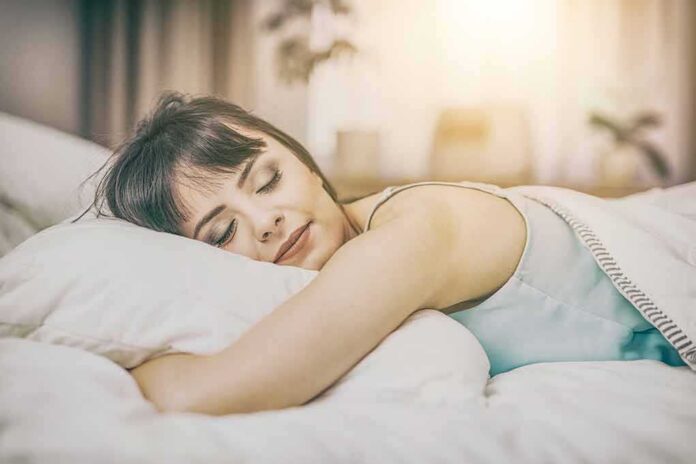
Sleeping in on Saturday by one to two hours is linked to a lower risk of depression and anxiety, according to a major new study of nearly 92,000 adults.
Quick Take
- A UK Biobank study tracked 91,665 adults for almost eight years using wrist-worn sleep trackers, not memory or guesswork.
- People who slept one to two extra hours on weekends had notably lower rates of depression and anxiety.
- Sleeping in by two hours or more did not show the same benefit, showing more is not always better.
- The findings are a correlation from observed habits, not proof that adding weekend sleep will prevent mental illness.
What The Research Actually Measured
Researchers behind the study, published through the UK Biobank and the Journal of Affective Disorders, didn’t ask people to recall their sleep habits from memory. They used accelerometers, wrist devices that track movement and rest, to measure real sleep patterns. That approach cut out the guesswork that plagues surveys asking “how much did you sleep last weekend?” Nearly eight years of follow-up data gave the team a long runway to watch depression and anxiety diagnoses unfold.
The results split people into groups based on how much extra sleep they banked on weekends compared to weekdays. The group getting one to two extra hours had a depression risk 18 percent lower than those with no catch-up sleep, with a hazard ratio of 0.82. That same group saw anxiety risk drop by 12 percent. Even a smaller bump of under one hour showed a modest depression benefit, suggesting the pattern isn’t limited to one narrow window.
Why More Sleep Wasn’t Always Better
Here’s the twist that keeps this from becoming a simple “sleep more” headline. The study found a nonlinear relationship, meaning benefits didn’t keep climbing as weekend sleep increased. People who slept in by two hours or more did not get the same protective effect seen in the moderate group. Public summaries of the findings made clear the sweet spot sits in that one-to-two-hour range, not beyond it.
That detail matters for anyone tempted to treat Sunday as an all-day nap marathon. Oversleeping on weekends has long been tied to its own problems, including grogginess and disrupted body clocks heading into Monday. This study adds weight to the idea that moderation, not maximum rest, is what tracks with better mental health outcomes among people who already run short on sleep during the week.
What This Study Does Not Prove
The study shows an association, not a guarantee. Researchers tracked natural sleep behavior and then watched who developed depression or anxiety later. Nobody was randomly assigned to sleep in or stay on a fixed schedule, so the design can’t rule out other explanations. People already feeling mentally well might simply be more likely to relax and sleep in on weekends in the first place.
The sleep tracking also only covered about one week per participant, a snapshot used to represent years of behavior. And the UK Biobank is a volunteer group, skewing toward people who chose to join a long-term health study, not a random slice of the public. None of that erases the finding. It just means the honest takeaway is “linked to,” not “causes.”
How This Fits Into The Bigger Sleep Picture
This isn’t the only sleep study making waves. A separate UK Biobank analysis found no link between weekend catch-up sleep and heart disease or death risk, a reminder that sleep research doesn’t hand out across-the-board protective effects for every health outcome. Other recent work has pointed toward sleep regularity, going to bed and waking at consistent times, as its own strong predictor of better mental health, separate from how long people sleep.
Taken together, the research points toward a nuanced picture. A modest weekend sleep-in may help blunt the toll of a tough work week, but consistency and moderation seem to matter just as much as the extra hours themselves. For readers chasing a quick fix, the honest message is less flashy than a headline promising a cure, but it’s grounded in real, measured data collected from tens of thousands of people over the better part of a decade.
“I’ll catch up on sleep this weekend.”
Sleeping longer over the weekend may seem like an easy way to recover from a tiring week. But what if you still feel exhausted?
Sleep difficulties can affect more than your energy levels. They may also impact your concentration, mood, and… pic.twitter.com/iJieZZNE8v
— Saudi German Health UAE (@SGHUAE) October 12, 2026
Until researchers run a true experiment, randomly assigning people to sleep schedules and measuring the results, this remains the strongest evidence available. And for now, it suggests one simple habit worth protecting: let yourself sleep in a little this weekend, just not for the whole day.
Sources:
mindbodygreen.com, biobank.ndph.ox.ac.uk, sciencedirect.com, bps.org.uk, ukbiobank.ac.uk