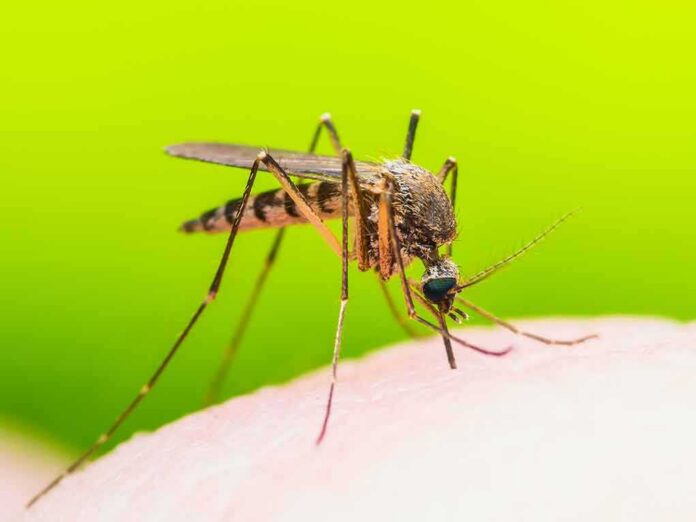
Whether you’re a “mosquito magnet” or simply unlucky in the wrong backyard at the wrong hour, the measures that actually reduce bites are not in dispute — they are the same five-point protocol repeated, almost word for word, by every major public health authority on the subject.
Key Points
- CDC, EPA, and clinical authorities converge on an identical prevention package: EPA-registered repellent, protective and permethrin-treated clothing, screens and netting, and elimination of standing water
- Standing water removal is the single most consequential habitat intervention, since it targets the larval stage before mosquitoes ever reach a person
- Infants require distinct precautions — netting over strollers and carriers, plus intact window and door screens
- The evidence base is strong on individual measures but thin on how much they add up when combined, and on how much of mosquito risk is genuinely within a household’s control
Why Some People Seem to Attract More Bites
Anecdotally, it always seems as though one person at the barbecue gets swarmed while everyone else escapes unscathed. Individual variation in body heat, carbon dioxide output, and skin chemistry plausibly explains part of that pattern, and it is a genuine area of entomological research. But the practical advice that public health agencies issue does not hinge on figuring out why any one person is more attractive to mosquitoes — it focuses on the two control points anyone can act on regardless of biology: shielding exposed skin and eliminating the conditions that let mosquitoes breed nearby in the first place.
The Repellent-and-Clothing Layer: Where the Consensus Is Strongest
The CDC’s guidance is explicit and specific: use EPA-registered insect repellents, wear loose-fitting long sleeves and pants, and consider clothing or gear treated with permethrin, an insecticide that remains effective through multiple washes. NSW Health adds a detail worth taking seriously — mosquitoes can bite through tight clothing, so looser, light-colored fabric offers more real protection than a long sleeve alone, particularly at dawn and dusk when mosquito activity peaks. The American Academy of Dermatology narrows the repellent recommendation further, advising products containing 20 to 30 percent DEET on exposed skin and clothing, applied after sunscreen and reapplied on the manufacturer’s schedule.
What makes this layer of advice unusually credible is not any single source but the redundancy across sources that have no institutional reason to copy one another. The EPA, the CDC, an Australian state health department, the National Pesticide Information Center, and clinical outlets such as Cleveland Clinic and UCLA Health all arrive independently at the same short list of active ingredients and clothing strategies. When five or six unrelated authorities converge on identical operational advice, that convergence itself is a form of evidence — it means the guidance has survived scrutiny across different institutional lenses, not just one agency’s internal review.
Eliminating the Breeding Ground: The Overlooked Half of the Equation
Repellent and clothing protect the person standing in the yard; they do nothing about the mosquitoes multiplying twenty feet away. That is why the EPA’s guidance leads with source reduction — eliminating standing water in rain gutters, old tires, buckets, plastic covers, and toys, anywhere water can collect and let mosquito larvae complete their aquatic life stage. The CDC translates this into a concrete weekly habit: empty and scrub, turn over, cover, or discard any item that holds water, including birdbaths, flowerpot saucers, and trash containers. This is not a minor supplement to personal protection — it is arguably the higher-leverage intervention, because a single neglected container can produce enough mosquitoes to undermine every repellent application in the neighborhood.
NSW Health frames the same principle slightly differently, recommending that pot-plant bases be filled with sand rather than left to collect rainwater, and that bird baths be emptied and refreshed regularly. The consistency of this advice across jurisdictions with very different mosquito species and disease burdens — dengue-carrying Aedes in parts of Australia versus West Nile-carrying Culex across much of North America — suggests the underlying mechanism (no standing water, no larvae, no adult mosquitoes) is close to a biological universal rather than a regional quirk.
Protecting Infants and Sealing the Home
Households with infants face a version of this advice tailored to a population that cannot apply repellent or wear long sleeves the way adults do. The CDC recommends covering strollers and baby carriers with mosquito netting and keeping screens on windows and doors in good repair, closing off the routes mosquitoes use to get indoors in the first place. The National Pesticide Information Center reinforces the screen-and-netting approach for anyone staying somewhere without reliable air conditioning or sealed doors, suggesting bed nets — some insecticide-treated — as a backup layer when screens are absent or compromised. This is precautionary rather than trial-tested advice specific to infants, but it follows the same logic that underlies the rest of the protocol: block the bite before it happens, rather than treat it afterward.
Where the Evidence Runs Thin — and Why That Matters
None of this is to say the case is airtight in every dimension. The available public health literature validates each measure individually — repellent works, standing water breeds mosquitoes, screens keep them out — but it does not quantify how much protection you gain by stacking all four together versus doing just one or two well. There is also no local entomological data embedded in general guidance: species behavior, seasonal risk, and biting patterns vary by region, and a household in coastal Florida faces a different practical calculus than one in inland Arizona, even though the CDC and EPA checklists read identically for both. Readers should treat the protocol as a well-validated floor, not a precisely calibrated ceiling.
The Limits of Treating This as a Personal Responsibility Problem
There is a subtler risk in how this advice gets delivered, particularly in short-form video and social content: it can imply that mosquito exposure is fully within an individual household’s control. It isn’t. Municipal drainage, storm-water management, and neighborhood-level waste collection do as much to determine local mosquito density as any single family’s weekly container check. A homeowner who diligently empties every birdbath can still be overrun if a neighboring property, a clogged public drain, or an abandoned pool nearby is breeding mosquitoes at scale. The advice from CDC and EPA is sound and worth following exactly as written — but it works best as a complement to, not a substitute for, community-level vector control, and readers in high-risk areas should treat persistent problems as a cue to contact local mosquito-control authorities rather than assume a personal failure of diligence.
Sources:
youtube.com, cdc.gov, nationalgeographic.com, health.nsw.gov.au, npic.orst.edu, mayoclinic.org