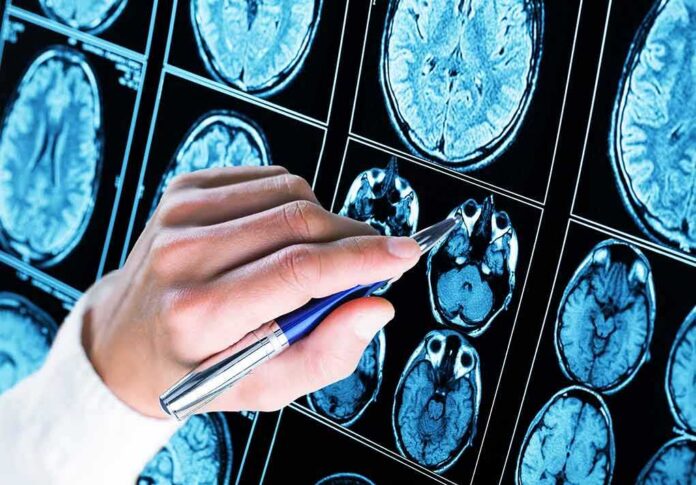
Millions of people who caught COVID-19 still cannot think straight months or years later, and doctors are now zeroing in on what might be happening inside their brains.
Quick Take
- Johns Hopkins Medicine confirms some COVID survivors develop lasting brain fog, fatigue, headaches, and dizziness.
- Researchers point to a leaky blood-brain barrier as one likely driver of these lingering symptoms.
- Medical reviews name several other possible causes, including inflammation, damaged blood vessels, and low oxygen to brain tissue.
- No single test or scan yet proves which mechanism causes symptoms in any one patient.
What Johns Hopkins Says About Long COVID And The Brain
Johns Hopkins Medicine states plainly that some COVID survivors develop medium to long-term symptoms after infection, including brain fog, fatigue, headaches, and dizziness. This is not a fringe claim from one clinic. It matches what hospitals and research teams worldwide have reported since the pandemic’s early waves, when patients kept describing a mental cloudiness that refused to lift long after their lungs cleared.
Johns Hopkins-affiliated researchers have gone further, identifying a specific physical process that may explain the fog. Their published work states that disruption of the blood-brain barrier, the protective wall that normally keeps harmful substances out of brain tissue, may contribute to the neuropsychiatric symptoms seen in Long COVID patients. When that barrier weakens, inflammation and other unwanted material can reach the brain more easily than it should.
That finding lines up with a growing body of outside research. Scientists have scanned brains of Long COVID patients and found reduced dopamine nerve activity, altered blood flow, and inflammation markers that healthy people do not show. None of this proves one single cause. It does show doctors are no longer guessing in the dark about why so many patients still struggle to concentrate, remember simple tasks, or shake constant exhaustion.
A Crowded Field Of Competing But Overlapping Explanations
A major review in Nature Reviews Microbiology lists the leading suspects behind Long COVID brain damage: neuroinflammation, blood vessel damage from clotting problems, endothelial dysfunction, and direct injury to nerve cells. That is four separate pathways, any of which could explain a patient’s symptoms, and they likely overlap in ways researchers are still mapping out.
A separate review acknowledges the honest truth up front: the mechanisms of Long COVID remain unclear. Scientists list overlapping theories, including immune system changes, leftover viral fragments driving chronic inflammation, damaged blood vessel linings, tiny blood clots, and even damaged energy-producing structures inside cells. This is not scientific failure. It is what it looks like when researchers chase a genuinely complicated problem honestly instead of forcing a tidy answer too early.
Cognitive symptoms themselves are well documented across the research. One review notes that Long COVID’s neurological phase commonly involves problems with thinking, sleep, sense of smell, mood, and headaches. Patients are not imagining these problems. The challenge facing doctors is pinpointing exactly which biological process, or combination of processes, produces them in each individual case.
Why Pinning Down The Mechanism Actually Matters
This is not an academic exercise. If blood-brain barrier damage turns out to be the main driver for a large share of patients, treatments could target that barrier directly. If inflammation or clotting problems are doing more of the damage, entirely different drugs would make sense. Getting the mechanism right determines whether millions of frustrated patients finally get treatments that work instead of trial-and-error guesswork.
Patients have waited years for medicine to take brain fog seriously as a real, measurable condition rather than a vague complaint. The fact that respected institutions are now publishing mechanism-level research, rather than just acknowledging symptoms exist, marks real progress. Common sense says you cannot fix what you cannot explain, and this research represents the explaining stage finally catching up to patient experience.
“brain imaging study led by scientists at the Centre for Addiction and Mental Health (CAMH) has uncovered what researchers describe as the strongest evidence so far that long COVID is associated with damage to dopamine-releasing neurons in the brain.”https://t.co/90u7okMAHs
— BethBPersist🏳️🌈 ✍️😷💉 ☣️ (@BethH_persist) October 6, 2026
None of this amounts to a finished scientific picture yet, and researchers still describe multiple plausible pathways rather than one proven cause. That is a normal stage for a newly recognized condition, not a reason to dismiss the symptoms millions of Americans continue to report. The science is moving, and for patients who have been told for years that nothing is physically wrong with them, that movement matters.
Sources:
youtube.com, pmc.ncbi.nlm.nih.gov, onlinelibrary.wiley.com