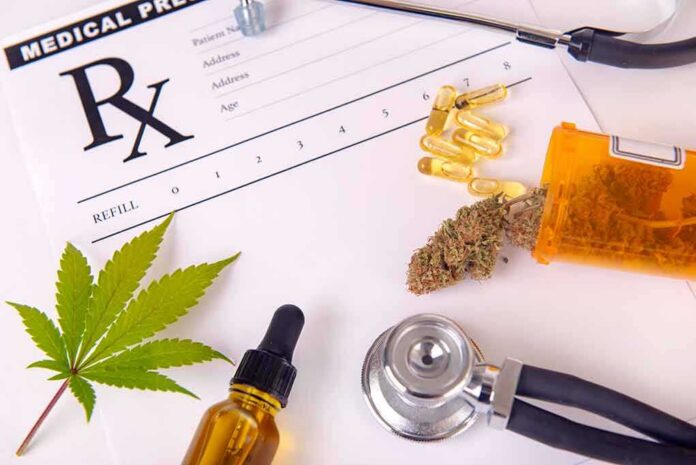
The most treatment-resistant symptom of post-traumatic stress disorder has always been the one patients can’t outrun even in sleep — the recurring nightmare that hijacks the night years after the trauma itself has ended — and a rigorously designed German trial has now shown that a prescription form of THC can silence those nightmares completely in more than a third of sufferers.
Key Points
- A phase II, randomized, double-blind, placebo-controlled trial run by Charité in Berlin tested oral dronabinol, a pharmaceutical THC, against placebo in 170-plus PTSD patients with frequent nightmares over 10 weeks.
- More than half of dronabinol patients responded to treatment, and over a third experienced complete disappearance of their nightmares, versus a much smaller response in the placebo group.
- The benefit appears specific to nightmares and sleep disturbance rather than PTSD symptoms broadly, and the trial did not compare dronabinol against standard nightmare therapies like prazosin.
- Professional psychiatric bodies have long treated cannabinoid evidence for PTSD as thin and preliminary, and this single trial, however well-designed, doesn’t yet overturn that caution.
- Questions about durability beyond 10 weeks, long-term safety, and the full adverse-event picture remain open and require further study.
What the Trial Actually Tested
Nightmares in PTSD are not garden-variety bad dreams. They are intrusive re-enactments of trauma, often nightly, that fragment sleep and reinforce the hyperarousal loop at the center of the disorder. Standard pharmacologic options are limited — the alpha-blocker prazosin has decades of clinical use but an inconsistent evidence trail, and psychotherapies like imagery rehearsal therapy require sustained engagement many patients in crisis can’t sustain. Into that gap stepped a team at Charité, which designed a multicenter, double-blind, 1:1 randomized, placebo-controlled, parallel-group study explicitly built to test whether oral dronabinol reduces nightmare frequency and intensity as its primary endpoint.
Dronabinol is not raw cannabis. It’s a synthetic formulation of delta-9-tetrahydrocannabinol, the psychoactive compound in the cannabis plant, already approved in various jurisdictions for chemotherapy-induced nausea and appetite loss in AIDS-related wasting. Repurposing it for nightmares wasn’t a leap from nowhere — smaller and older work with nabilone, a related synthetic cannabinoid, had already shown that cannabinoid receptor agonists could blunt the intensity of recurring trauma dreams in open-label and cross-over studies. What distinguished the Charité trial was scale and rigor: more than 170 enrolled patients, four sites, a full placebo arm, and a 10-week intervention window with prespecified outcome measures, the kind of design that produces results a clinician can actually weigh.
The Results, and Why They’re Notable
The topline finding, published in Nature Medicine and summarized by Charité’s own press office, was that dronabinol patients saw a statistically significant reduction in nightmare burden compared with placebo. More than half the treated group responded to the medication in some measurable way, and over a third reported their nightmares vanishing entirely by the end of the trial — a remission rate that would be remarkable for almost any psychiatric intervention, let alone one aimed at a symptom notoriously resistant to treatment. An additional roughly one-fifth of patients experienced at least a substantial partial reduction, meaning close to 60% of those on dronabinol got meaningful relief in one form or another.
Nightmare severity scores, tracked on a standardized clinical scale, dropped by an average of nearly four points more in the treatment group than in placebo. That’s a large effect size in sleep-medicine terms, and it arrived alongside a tolerability profile that the institutional summary characterized as free of severe side effects, with the more common complaints being the sort of things familiar to anyone who has used THC recreationally — dizziness, headache, increased appetite. Crucially, the effect appeared concentrated on nightmares and sleep specifically, not on the full constellation of PTSD symptoms such as avoidance, hypervigilance, or intrusive daytime memories. That specificity is scientifically interesting — it suggests dronabinol is acting on the sleep-and-dream circuitry of trauma rather than the disorder’s broader architecture — but it also tempers any claim that this is a cure for PTSD itself.
Where the Real Caution Belongs
None of this means the debate is settled, and the caution here is worth stating precisely rather than gesturally. This was a phase II trial — the stage in drug development designed to establish a signal and a safety profile, not the stage that settles clinical practice. The American Psychiatric Association’s own resource document on cannabis and PTSD, issued in 2019, describes the pre-existing cannabinoid literature bluntly: no published high-quality randomized controlled trials existed for either botanical cannabis or synthetic cannabinoids in PTSD outcomes at that point, with the strongest prior dronabinol evidence being a single open-label pilot study of just ten patients and no control group. The Charité trial is a genuine step up from that baseline — it is exactly the kind of rigorous, adequately powered study the APA said was missing — but one well-run trial, however impressive its numbers, is not the same thing as a replicated evidence base.
What Comes Next
The honest read on this research is that it’s the strongest evidence yet that a THC-derived medication can meaningfully treat one of PTSD’s cruelest symptoms, produced by a properly blinded and adequately sized trial rather than the small open-label studies that dominated this field for years. It also fits a familiar arc in cannabinoid psychiatry: an early proof-of-concept generates real optimism, professional bodies urge patience pending replication, and the field spends the next several years running the comparative and long-term studies that turn a promising phase II result into an accepted clinical option — or don’t. For the patient lying awake at 3 a.m. dreading sleep because of what waits there, that distinction matters less than the fact that, for the first time, a rigorously tested medicine gave a real chance the dream simply wouldn’t come.
Sources:
sciencedaily.com, pmc.ncbi.nlm.nih.gov, charite.de, neurosciencenews.com, trial.medpath.com, psychiatry.org, semanticscholar.org, withpower.com